COM326 Assignment 2 – Create a non-digital game
When I took a first look at the assignment brief, I was both excited and nervous at the prospect of having to make a game from scratch and test it with my fellow students. I am sure everyone was experiencing the same mix of feelings. We were going to get to make our first game! Very exciting! No narrow brief on what the game should be about or even the type of game, the only caveat being that it was to be a non-digital one. This was to be then played with our peers and reflected on. This was the nerve-wracking element. Complicated further by the fact that we are bang in the middle of a global pandemic and national lockdown. We are yet to set foot in the University buildings despite getting to the end of semester one. Games were going to have to be played via the internet and webcams. This added a much greater challenge to the task ahead!
Coming up with a workable idea and how to make it function via webcam was going to be tricky. I briefly considered using tabletop simulator but felt this would be a bit of a cop-out, as the task was to make a non-digital game.
I quickly settled on wanting to make a board game above all other choices. I love board games just as much as I love computer games. I grew up in a family who all loved them too, so it would be a regular rainy Sunday afternoon pastime and chance for us to get together.
So what type of boardgame was I going to make? I remembered an old horse racing board game I loved as a child – ‘Totopoly’. It was great to see peoples competitive spirit come out, and there was genuine excitement when you were neck and neck with another player racing round. I had recently watched the Mad Max: Fury Road film again as my girlfriend hadn’t seen it and was a fan of the original. I thought it might be interesting to try and create some kind of Mad-Max style ‘racing with combat elements’ type of game, with a bit of Mario Kart influence thrown in.
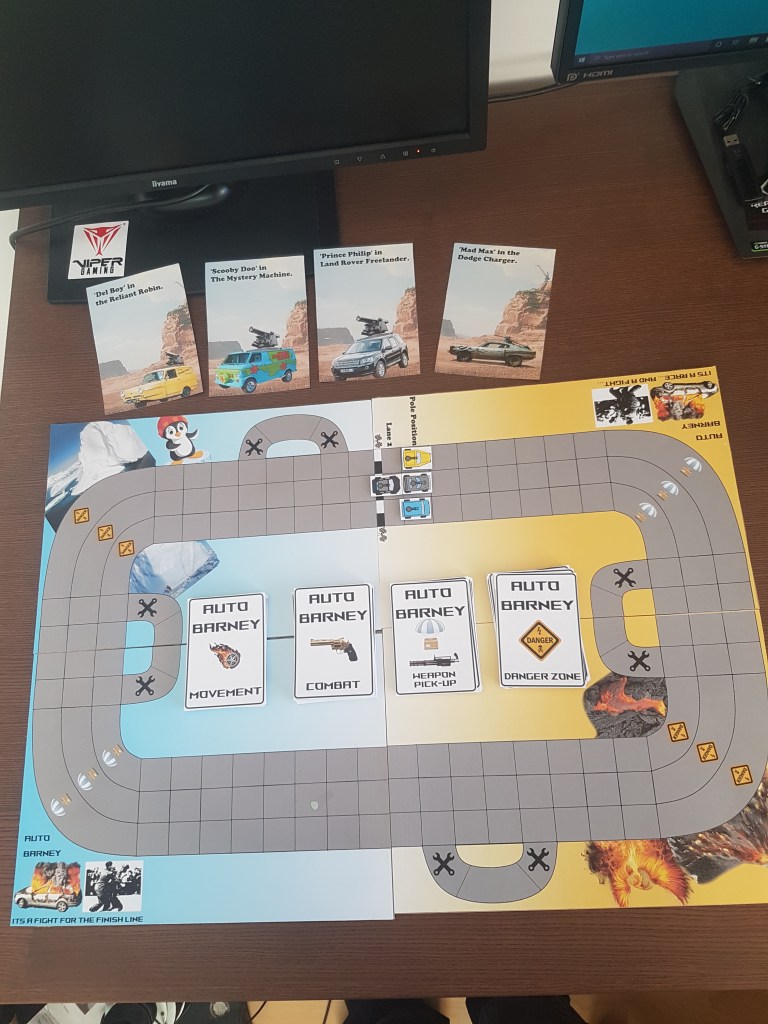
So using Paint.Net and Aseprite I set about designing and making a board, counters and cards. I quickly abandoned the idea of using rulers etc to measure distance round a track in favour of a grid system. I felt it was important to keep it relatively simple as we were not going to be able to all sit round a table and test it. I would be moving the others counters as well as drawing their cards for them for any movement and combat.
I decided not to test the game at all before our designated testing day. Part of me wanted to out of curiosity, but part of me was equally fearful that it simply wouldn’t work for some reason, or that it might not feel fun to play. I had already spent many hours working on it, and it was far too late to start again from scratch. I had some arbitrary figures for things like hit points, range and damage in my head, but I had no idea if these would pan out to be playable.
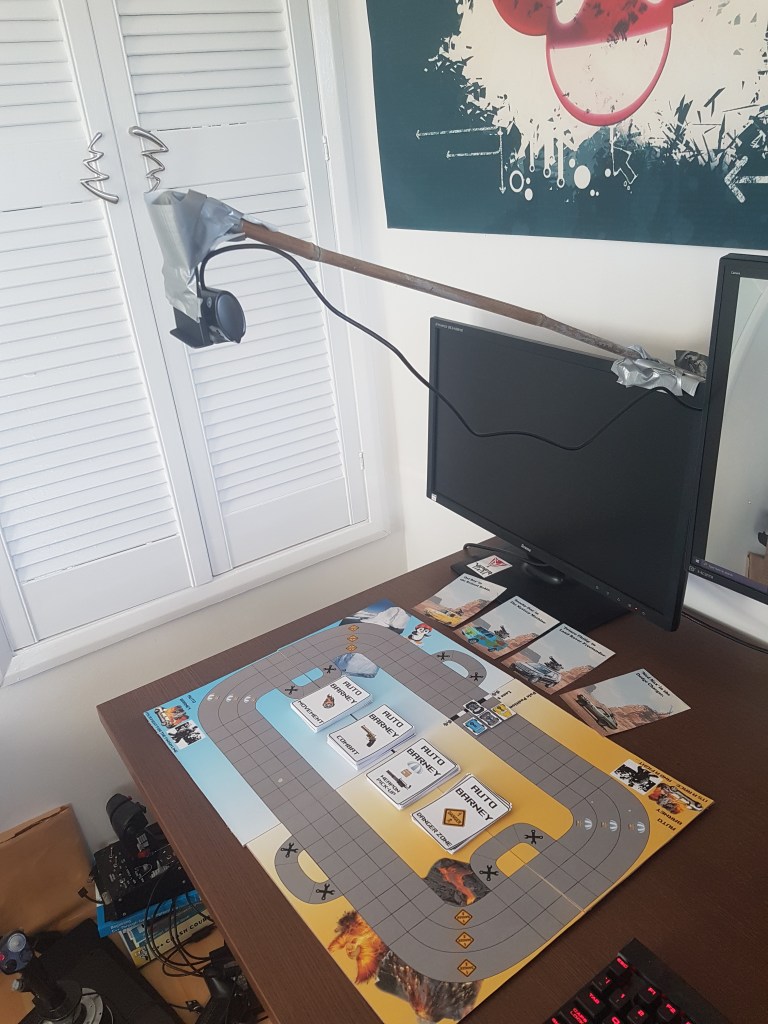
Testing day arrived and I set up the webcam over the board and checked that the image was clear enough. This involved a bit of a ‘blue-peter’ style set up with half a garden cane and some duct-tape, but it seemed to work well enough. It was interesting to see what other people had come up with and all the other games were fun to play. I think we were all a bit nervous having never actually met each other but everyone seemed enthusiastic about the playtesting session.
We each had a 45 minute window to test our games and emerge with enough material to reflect on our games. I went second to last out of the five of us. I was quite conscious of the limited time frame but hoped we could squeeze in one full lap in the 45 minutes to give a fair reflection of the game and some kind of closure to the test. With four players I offered to toss a coin to determine who would start in pole position, and who in lane 2. Typically enough I managed to get heads for all four players so a re-toss was needed. We ended up with two in pole position lane and two in lane 2 – a fair result.
I had tried to make the game as light-hearted and fun despite its competitive nature. Players were assigned their own characters including Scooby-doo, Del Boy and Prince Philip as well as Mad-Max. These were purely cosmetic. No advantages were added by ending up with any character although that could be an element for consideration in retrospect. Perhaps one with a slower, stronger vehicle and one with a faster, more fragile one. I wanted to keep it simple.
I briefly explained most of the rules but I wanted to get things moving due to the limited time frame so there was definitely an element of learn to play as you go happening. I didn’t want to spend 10 minutes going through every intricacy and thought it would be better to explain the basics then get going. The players seemed enthusiastic from the start and despite the fact I was having to draw all the cards for movement etc and show them to the camera, the race seemed to move at a reasonable pace. I think had we all been sat at a table playing it could run even more quickly with practice.
The one area where I wanted to keep an element of secrecy as to what cards had been drawn by a player were the weapon pick-ups. I felt it would be a bit more fun if other players didn’t know what secret weapon their opponents had up their sleeve to use on them at any moment. For this reason I asked the other players to turn away from the screen when someone picked up a weapon.
Having not done a great job at explaining the combat mechanics of the game at the start, nobody was really attempting a shot or ramming early in the game. In retrospect I would have spent a bit more time explaining the pros and cons of attacking other players and we might have seen more action along those lines in the earlier stages! As it was people just seemed happy to race along to start with.
I had set the danger zone cards so that there was a 1 in 3 chance of damage so high you went into limp mode. Everyone has to draw a danger zone card on passing through and I must have done a very bad job of shuffling the cards as sure enough the first three through all ended up in limp mode!
I had decided that limp mode would entail a movement penalty (I settled on restricting the max to 2 spaces per turn). I also decided that being in limp mode would mean that you couldn’t attack others and were forced to enter the next repair area on the track. The repair area was there to slow a player down as you could only move through at 1 square per turn, emerging with full hit points again. I was concerned that one player might end up very far in the lead while others went through the whole limp mode scenario, but there was always the chance that they might come a cropper at the next danger zone so I hoped this would balance things out somewhat.
In the playtest I think everyone went into limp mode at some point. The suggestion came up that players could choose to limp along rather than being forced to pull into the repair area. I thought I would let this idea run to see what happened – would having a maximum 2 for movement allow those who had gone through the repair area to catch up? It was the first playtest so felt it was probably important to not be too rigid with the rules and be a bit more explorative to see what did and didn’t work.
In practice one player did get several spaces ahead and proved to be ultimately uncatchable, although this was down to some bad luck when attempting to fire on him by others. A good win for Liam playing as ‘Prince Philip in the Landrover Freelander’.
So was it fun to play? Well the players seemed to react well and were certainly enthusiastic and competitive, and I hope we had a bit of a laugh playing. Feedback and suggestions were inventive and constructive and all worthy of consideration. I think the players felt that losing all your hit points and being in limp mode needed to be a harsher penalty. That being hit by a weapon successfully while in limp mode could result in no movement the next turn (missing a go effectively) might work better. I am inclined to agree.
Other suggestions that I think are worthy and would certainly make it a better game would be the use of short-cuts that pass through a danger zone, or use of the ‘racing line’ at some risk. Where obtaining an advantage in the race vs the risk of damaging the vehicle becomes a choice the player has to weigh up.
Overall, for a first test run I think it went ok. It was played with more enthusiasm than I could ever have hoped for thanks to a good crew of enthusiastic play testers. We managed to complete 1 lap in the time allowed and it was a relatively close run as players approached the finish line.
 Geoffwinton.com