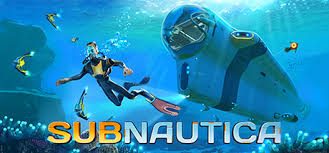

Why Subnautica?
Subnautica has captivated me more than any game I have played this year. It has some areas of design development that are worthy of deeper examination. It has been referred to by some as an underrated masterpiece and I must agree. This case study will attempt to get to the root of why it’s such a brilliant game, while considering design decisions based on gameplay, mechanics and any limitations faced by the developers.
Subnautica is essentially a survival / exploration / crafting game. Unusual in that it is set almost entirely underwater on an alien planet, the relatively small development team (Unknown Worlds) have managed to create an extremely well balanced, absorbing game. Open world with a great storyline that helps prevent any boredom from pure exploration without dragging the player down a linear, hand-held path. The game opens with the player being jettisoned from a spaceship (‘the Aurora’) in a life-pod which lands in open water on an alien world. From here, the player begins an adventure which can be lonely, breath-taking, disorientating, exciting, truly terrifying and ultimately deeply rewarding.
Development and early access
Unknown worlds faced many challenges during development. Despite a relatively successful previous game (first person shooter Natural Selection 2), funds were tight. After 18 months of work bringing Subnautica from prototype to minimum viable product, funds had run out. It had a successful demo at the PAX East game conference 6 months earlier, so the decision was taken to bring the game out in ‘early access’ in December 2014. The game would spend just over 3 years in continual development with early access, the final release taking place in January 2018.
Early access can be a gamble. On the one hand it allows feedback from players as to progression and buys some time to create the finished product. On the other hand, players can be turned off by the lack of polish and sheer number of bugs that are prevalent in unfinished games. Thankfully most players loved the game even in its early stages and saw the promise of something unique and exciting in the making.
The developers included a clever feature in adding ‘one button feedback’. Hitting the F8 key at any time during gameplay would bring up a feedback sheet where players could report bugs or give positive or negative feedback. It would record the players location in the gameworld at that time, so the developers could quickly fix or change anything needed. The data collected was available to everyone, not just the developers. In this way the players themselves shaped the game and contributed hugely to the finished product.
Design decisions
Despite early access games being largely player driven, occasionally developers need to dig their heels in and stick to their original plan. Many Subnautica players were asking for guns to be included to fight against the more aggressive creatures in the game. Despite their previous game being a gun-heavy FPS, lead developer Charlie Cleveland decided early on that he was frustrated with the constant gun violence in his home country (USA) and wanted to create a game that allowed people to escape from this. This decision was directly influenced by development starting shortly after the Sandy Hook school massacre where 20 children aged 6-7 were killed.
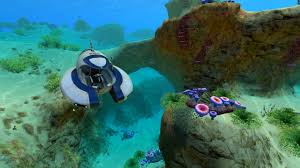
Combat was removed from the game loop in favour of the player collecting materials for crafting items to progress further and deeper. Oxygen tanks, an underwater base, two different sized submarines, a mech-suit with drilling arms and many other items can be crafted. So, having removed combat, how did they go about keeping excitement levels high in what is essentially an underwater exploration game? They introduced huge predatory ‘leviathan class’ creatures.

These creatures, particularly the ‘reaper leviathan’ (above), are terror inducing. The underwater gameworld is divided into 12 distinct ‘biomes’ each with differing plants and creatures. Each biome flows smoothly into the next as the underwater landscape changes. Some of these biomes contain creatures which can attack the player, damage submarines to the point of destruction and leave the player swimming away for their life! Many videos can be found on Youtube of twitch streamers ‘jump-scares’ as they encounter these creatures. The developers have joked that they created a horror game ‘accidentally’.
The gameworld is quite large, around 2km square and around 1600m deep in some areas. The player never actually has any kind of in-game map (a compass can be crafted to help with navigation). You know you have reached the edge of the play area as the landscape drops away sharply to unreachable depths. This is quite a clever technique to keep you in the gameworld as it doesn’t take away from the sense of immersion. There are no invisible barriers, just no reason to travel any further from the play area. Graphically the game is impressive. The world was hand crafted after the developers abandoned using a procedural generation technique as being too unrealistic. Placing every plant and resource obviously lengthened development time but it was well worth it. A popularly requested feature was multi-player, but this was never implemented as the developers felt they would have to start the game from scratch.
Early access and feedback provided the developers with great insight into how players reacted to the overall gameplay. Emotional design was a concept held as important. Provoking emotional responses in players like the stress of running low on oxygen, a sense of ‘the unknown’ as you enter a never explored biome or just floating above an abyss wondering what you are to discover down there can be awe inspiring.
Game loop and mechanics
Players start the game with very few possessions. The most important is a hand-held ‘scanner’. This can be used to scan creatures, plants and any parts of wreckage from the crashed spaceship that can be found scattered around the seabed. Scanning wreckage unlocks ‘blueprints’ of useful items that can then be crafted from gathered materials. Data from the scanner is uploaded to a ‘PDA’. This can be viewed at any time and shows all sorts of information including your inventory.
Placing constrictions on players is an important game mechanic employed by Subnautica. Without them the whole gameworld would be open to immediate exploration and take away the sense of progression and achievement that is so important to keep players interested. The most important of these is oxygen.
Players have only the oxygen they can hold in their lungs on starting and this quickly ticks away restricting how deep you can dive down before returning to the surface or risk drowning. As more materials and blueprints are gathered, deeper longer exploration is unlocked. This is a compelling mechanic and keeps the player coming back with a desire to go deeper and explore further. The mystery of the depths keeps players returning to the game, what beautiful sights or terrifying creatures are to be found? The sense of power and freedom when you craft your first underwater vehicle is immense. The players sense of vulnerability gradually reduces on progression but never totally disappears.
The survival mechanics of the game mean that a player needs to keep a watch on their food and water levels. These meters gradually tick away until replenished and can result in death through dehydration or starvation if not addressed. Water and food are easy enough to come by and the mechanic is not regularly intrusive enough to frustrate players, but will encourage them to be organised and prepared if embarking on a long journey to the depths for example.
Final thoughts
The danger with exploration games is player boredom. Subnautica never feels tiresome. Radio messages from other abandoned lifepods attract the player to new biomes and gradually a story develops. Infected with a virus on landing, the player must ultimately find a cure for this and build an escape rocket. Finishing the game leaves you satisfied with a feeling of a beautiful, exciting adventure completed.
*** WARNING – THERE MAY BE A LITTLE BIT OF SWEARING IN THIS YOUTUBE VID 🙂 ***
 Geoffwinton.com